

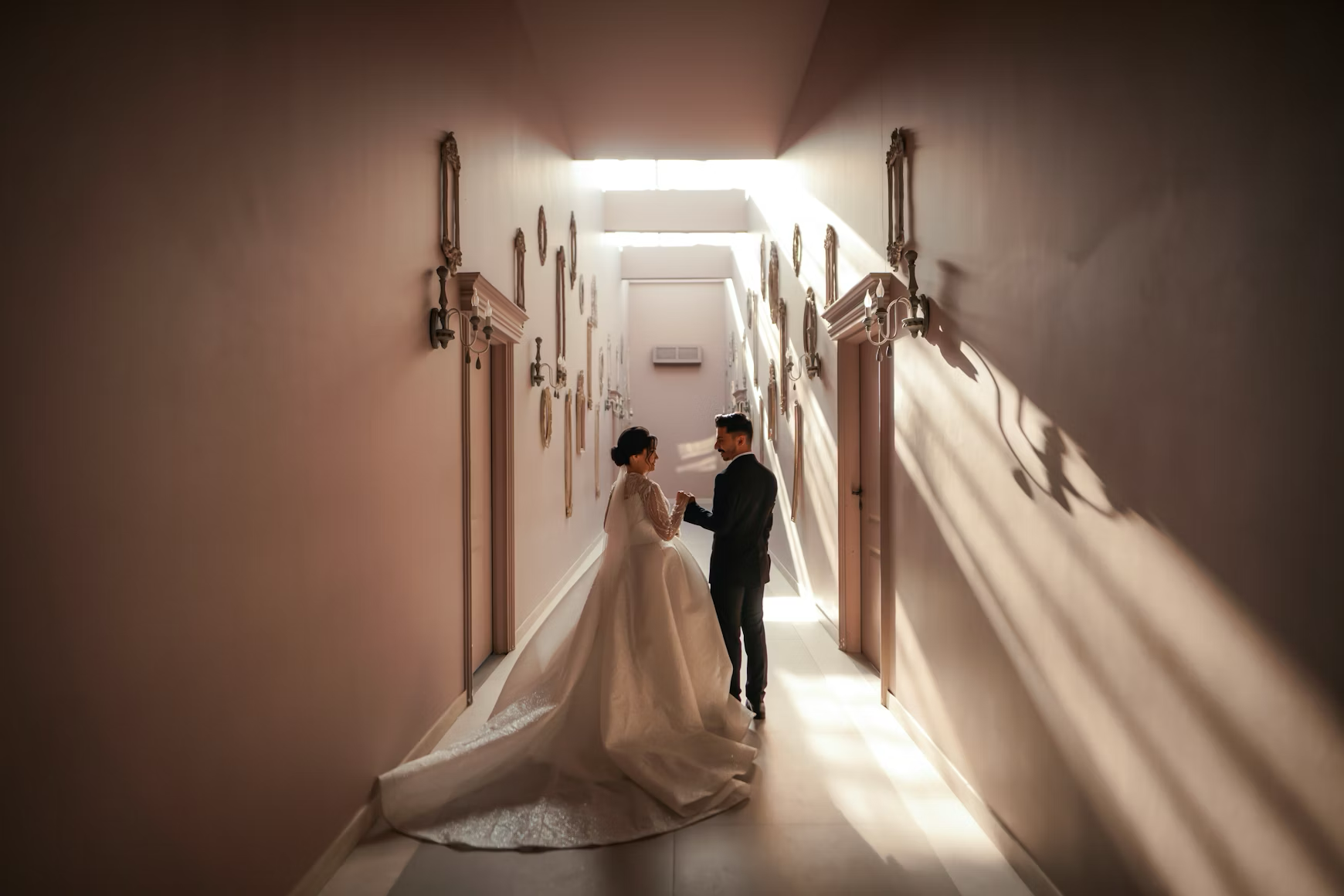
In the weeks leading up to a wedding, life slowly narrows toward a single point in the future. Time is measured in countdowns, decisions stack on top of each other, and most conversations begin to circle the same center. Attention keeps drifting forward, pulled by whatever still hasn’t been decided, confirmed, or finalized.
Then the day happens. And almost immediately, that organizing force disappears. For some couples, what follows feels like an emotional drop that’s hard to name. A quiet disorientation settles in, accompanied by the sense that something internal has shifted before the mind has caught up.
This experience is often described as post-wedding blues, but that phrase can flatten what’s actually happening. After the wedding, many couples find themselves adjusting not just to the end of an event, but to the disappearance of the structure that had been giving their days a shared sense of direction.
When Momentum Stops Before Meaning Arrives
There is always a next task, a next decision, a next milestone that suggests progress.
Once the planning ends, that forward pull vanishes. Daily life resumes while the internal pacing lags behind, as the relationship moves into a new terrain that the emotional system is still learning how to inhabit.
Excitement may still be there, but without the shared structure that once pointed everything forward, it no longer knows where to land.
The Gap Between Imagined Futures and Lived Reality
For months, sometimes years, marriage remains a future-oriented idea, carried through anticipation and preparation more than through day-to-day reality. The wedding marks the moment when that imagined future becomes a lived condition.
Even when the relationship is solid, this transition can register as a kind of loss. It isn’t a loss of love, but a quiet shift away from the openness that existed before everything had a name or a structure.
Many couples don’t expect this feeling at all, largely because it doesn’t announce itself clearly. It shows up as mild confusion, a vague sense that something feels off in a way that’s difficult to name.
Emotional Asymmetry After the Day Ends
Disorientation often shows up unevenly. One partner may feel relief and calm, happy to be done with planning and ready to move forward. The other may feel flat, restless, or unexpectedly emotional. This difference can be hard to talk about, especially when the cultural expectation is shared bliss.
Weddings are often framed as peak moments, which makes uneven emotional timing feel alarming. That gap can easily be interpreted as something being wrong, even when it’s part of how transitions naturally register. But major shifts rarely arrive the same way for two people at once. Emotional timing offers insight into how each person is processing change.
The Loss of Collective Attention

During wedding planning, couples are rarely alone with their experience. Family checks in, friends ask questions, vendors respond quickly, and a steady sense of being witnessed settles in almost without notice.
After the wedding, that attention recedes almost overnight. Messages slow down. Group chats go quiet. The calendar that was once full suddenly looks blank. Life moves on for everyone else. For some couples, especially those who invested heavily in the social meaning of the day, this drop can feel surprisingly sharp.
What’s often missed is the experience of being held inside a shared narrative, where the moment belongs to more than one person. Once the story concludes, couples are left to author the next chapter quietly, without applause or clear markers.
When the Body Reacts Before the Mind Understands
Research and clinical writing often point to hormonal shifts after big events, and that explanation is valid. But it’s incomplete.
Disorientation isn’t only chemical. It also touches how people relate to each other and to the lives they’re stepping into. The body senses that something fundamental has changed before the mind has language for it.
This is why people sometimes feel unsettled without being able to explain why. The wedding didn’t go wrong. Marriage isn’t a mistake. Yet something internally is recalibrating, and that process can feel destabilizing before it feels grounded.
Not a Problem to Fix, but a Phase to Interpret
Mainstream advice often treats post-wedding disorientation as something to move through quickly, encouraging couples to plan ahead, stay busy, and shift focus to the marriage. Those strategies help, but they don’t address the deeper work of this period: integration.
Couples are learning how it feels to inhabit the commitment they’ve made, without the scaffolding of constant preparation. Disorientation often marks the period where something new is entering the system, before language or certainty has caught up. It’s the feeling of having crossed a bridge before realizing the ground behind you is gone.
What Settles Over Time
For most couples, the unsettled feeling doesn’t last forever. Orientation comes back in small ways, through routines and rhythms that slowly take hold again. Mornings without plans, grocery runs done together and evenings that don’t need to mean anything yet.
What follows are shared routines and quiet evenings, small decisions made together, as the relationship moves from anticipation into lived experience. The steadiness doesn’t arrive through memory alone. It builds as two people learn how it feels to keep moving forward together, without a script.
After planning falls away, the next phase doesn’t announce itself. With time, the stillness begins to register not as emptiness, but as space. And space, while initially disorienting, is often where something more durable begins to form.
